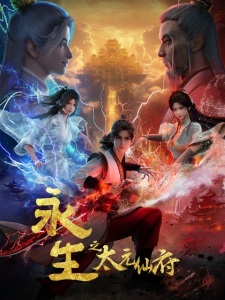
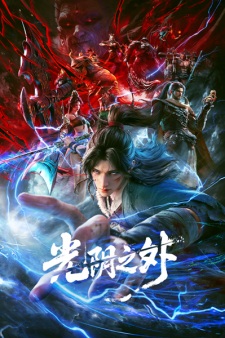
By the time Immortality: Tao Returns to One arrives, the Immortality franchise has already established itself as one of the darker and more ruthless cultivation stories in modern donghua. Adapted from the famous novel by Meng Ru Shen Ji, the series has never tried to present cultivation as a heroic fantasy. Instead, it portrays a brutal universe where power decides morality, survival demands sacrifice, and immortality itself becomes a curse as much as a blessing.
This newest arc, Tao Returns to One, represents a major turning point for the series. The scale becomes larger, the conflicts more philosophical, and the emotional atmosphere far heavier. What began as the rise of a determined young cultivator now transforms into a war against heavenly order itself.
The result is one of the most intense and ambitious arcs the franchise has produced so far.
Fang Han’s Evolution
At the center of the story remains Fang Han — one of the most morally gray protagonists in cultivation fiction.
Unlike traditional righteous heroes, Fang Han’s journey is driven by survival instinct, relentless ambition, and refusal to submit to fate. He does not seek justice or glory. He seeks strength — because in the world of Immortality, weakness means death.
This arc pushes his character further than previous seasons.
Fang Han is no longer simply a talented cultivator rising through sect politics. He has become someone capable of shaking the balance of entire immortal factions. The story constantly asks an important question:
What happens when a man who refuses heavenly control gains the power to challenge heaven itself?
This philosophical tension becomes the emotional core of the season.
A World Governed by Power
The cultivation world in Immortality is among the harshest in donghua storytelling.
Sect alliances are temporary. Loyalty is fragile. Ancient immortals manipulate entire generations for personal gain. Every realm of cultivation reveals deeper layers of corruption hidden beneath divine appearances.
Unlike simpler fantasy stories where good and evil are clearly separated, Tao Returns to One thrives in moral ambiguity.
The series presents:
- immortal sect conflicts,
- political betrayals,
- forbidden techniques,
- ancient heavenly treasures,
- dimensional warfare,
- and struggles against cosmic laws.
Each faction believes itself justified, yet nearly all are willing to sacrifice countless lives in pursuit of power.
This creates a constant atmosphere of tension where trust rarely survives for long.
The Meaning of “Tao Returns to One”
The title itself carries major thematic importance.
In Daoist philosophy, “returning to one” symbolizes returning to the origin of existence — the fundamental truth behind all things.
The series uses this concept both spiritually and narratively.
As Fang Han grows stronger, cultivation stops being merely about techniques or battles. He begins confronting deeper questions:
- What is immortality?
- Can humans escape destiny?
- Is heavenly order truly righteous?
- Does absolute power inevitably corrupt?
- Can one individual stand against the laws of existence?
These philosophical elements elevate the storytelling far beyond ordinary action fantasy.
The cultivation journey becomes existential.
Action and Battle Direction
The fights in Immortality are not simple exchanges of flashy attacks. Most battles feel like strategic clashes between cultivators who manipulate:
- spiritual laws,
- magical treasures,
- formations,
- dimensional space,
- and forbidden techniques.
Power scaling becomes increasingly cosmic, yet the animation still maintains clarity during combat.
The action direction successfully balances:
- speed,
- destruction,
- tactical movement,
- and cinematic tension.
Especially impressive are the large-scale immortal wars where entire environments collapse under spiritual pressure.
Visual Presentation
Tiangong Yicai continues delivering some of the most polished CGI cultivation visuals in modern donghua.
The visual identity of Tao Returns to One is darker and more mature compared to many brightly stylized fantasy series.
The animation emphasizes:
- ancient celestial architecture,
- massive spiritual domains,
- oppressive skies,
- glowing magical artifacts,
- and high-detail energy effects.
The cinematography often feels cinematic rather than episodic. Camera movement during major confrontations creates a strong sense of scale and power.
The series especially excels at portraying spiritual pressure — powerful cultivators genuinely feel terrifying.
Emotional Atmosphere
Despite its focus on power and cultivation, the series maintains strong emotional tension.
Fang Han’s path becomes increasingly lonely as his strength grows. Relationships are constantly threatened by:
- betrayal,
- ambition,
- sect warfare,
- and the corruptive influence of power.
Many characters are forced into impossible decisions where survival comes at enormous emotional cost.
The series repeatedly explores the tragedy of immortality:
The closer one gets to godhood, the further one drifts from ordinary humanity.
This melancholy atmosphere gives emotional depth to the story’s large-scale conflicts.
Pacing
The pacing is faster and more intense than earlier seasons.
Previous arcs spent considerable time building cultivation systems and sect politics. Tao Returns to One benefits from this foundation and moves more aggressively into major conflicts.
However, newcomers may find:
- terminology overwhelming,
- power systems complex,
- and political relationships difficult to follow.
This season assumes the audience already understands the world.
For longtime fans, though, the payoff is substantial.
Themes
The season explores several mature themes:
- rebellion against fate,
- corruption through power,
- survival morality,
- the isolation of immortality,
- transcendence,
- cosmic hierarchy,
- and humanity’s resistance against divine control.
Unlike many cultivation stories that glorify ascension, Immortality often portrays cultivation as psychologically destructive.
Strength grants freedom —
but also loneliness.
Music and Sound Design
The soundtrack effectively supports the darker atmosphere of the series.
Heavy orchestral tracks, ancient Chinese instrumentation, and haunting vocal themes reinforce the sense of epic tragedy surrounding Fang Han’s journey.
Sound design during battles is particularly strong:
- spiritual explosions feel massive,
- dimensional distortions sound unsettling,
- and quieter emotional scenes are given room to breathe.
Voice acting also remains one of the franchise’s underrated strengths, especially during morally conflicted scenes.
Strengths
What the Series Does Exceptionally Well
- Mature cultivation storytelling
- Morally gray protagonist
- Philosophical themes
- Large-scale worldbuilding
- Strategic battle choreography
- High-quality CGI animation
- Dark emotional atmosphere
- Strong sense of escalating stakes
Weaknesses
Potential Drawbacks
- Complex terminology may overwhelm new viewers
- Requires knowledge of previous arcs
- Heavy exposition in some episodes
- Secondary characters occasionally lack development
- Power scaling may become difficult to track for casual audiences
Overall Verdict
Immortality: Tao Returns to One is a powerful continuation of one of donghua’s most uncompromising cultivation epics.
Rather than focusing purely on spectacle, the series combines:
- philosophical storytelling,
- emotional tragedy,
- cosmic-scale warfare,
- and relentless character evolution.
Fang Han’s rise from powerless youth to challenger of heavenly order remains compelling precisely because the story never portrays power as simple or pure.
Every advancement carries consequences.
Every victory creates new enemies.
Every step toward immortality demands sacrifice.
For fans of dark xianxia fantasy, ruthless cultivation politics, and high-stakes immortal warfare, Tao Returns to One stands as one of the strongest recent arcs in Chinese animation.
Final Score
8.8/10 — A visually impressive and philosophically rich cultivation saga with powerful storytelling, intense battles, and one of donghua’s most compelling antihero protagonists.